
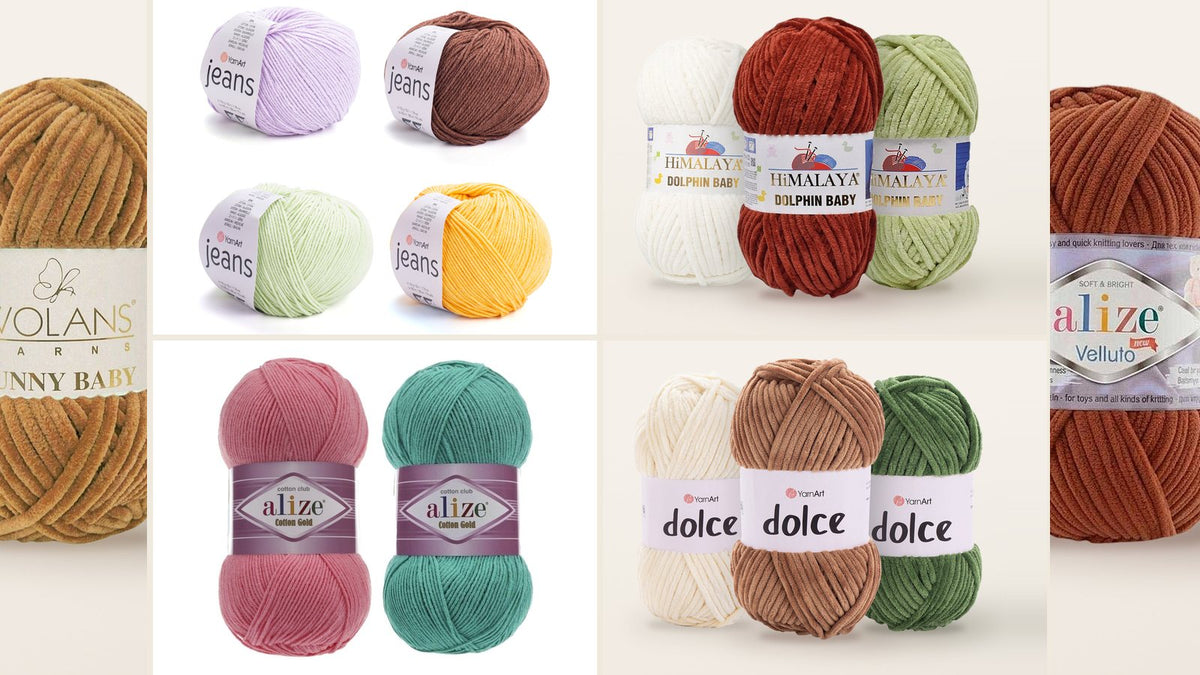
Choosing yarn for a crochet toy usually comes down to one question: do you want a toy with crisp shapes and clear details, or one that feels like a velvety shop-bought plush? This guide compares smooth cotton-type yarns with plush chenille, shows which is easier for a first toy, and then covers everything else you need to start: the hook, safety eyes, stuffing and the handful of stitches most amigurumi are built from.


The short answer
For most toys — and especially your first one — choose a smooth cotton or cotton-blend yarn. You can see every stitch, count rounds without guessing, unpick mistakes cleanly and shape small details such as ears, noses and fingers.
Choose plush chenille when softness and size matter more than detail. It makes big, squeezable toys with a velvety surface, and the thick strand grows quickly. The trade-off is that the stitches are hard to see, the yarn is less forgiving when you pull or unpick, and small features tend to disappear into the pile.
Neither is "better" overall. They suit different toys and different stages of experience.
Besides yarn, a first toy needs only a few things: a crochet hook, a little polyester stuffing, a stitch marker, a blunt yarn needle, and either safety eyes or embroidery for the face. Each is covered further down.

Cotton is a fibre, chenille is a construction
The comparison is a little lopsided, and it helps to know why.
- Cotton describes what a yarn is made from.
- Chenille describes how a yarn is built: short tufts of fibre (the pile) are trapped between twisted core threads, so they stand out from the core and create a velvety surface. Chenille can be made from different fibres, including cotton, but the plush chenille yarns most often used for amigurumi today are polyester. Himalaya Dolphin Baby, YarnArt Dolce, Wolans Bunny Baby and Alize Velluto are all listed by their manufacturers as 100% polyester or micro polyester.
So in practice, "cotton vs chenille" means a smooth, tightly spun cotton-type yarn vs a plush polyester chenille-style yarn.

A note on cotton blends
Many popular "cotton" amigurumi yarns are blends. YarnArt Jeans and Alize Cotton Gold are 55% cotton with 45% (poly)acrylic; Gazzal Baby Cotton is 60% cotton and 40% acrylic. They give you the smooth, matte look people associate with cotton toys, but they are not pure cotton — so check the composition and the care label rather than assuming pure-cotton behaviour. If you specifically want 100% cotton, look at the fibre content before you buy.
Side-by-side comparison
| Smooth cotton / cotton blend | Plush chenille-style yarn | |
|---|---|---|
| Seeing your stitches | Each stitch is clearly visible | The pile hides the stitch structure; many makers find stitches by feel |
| Details and shaping | Suits small features and defined shapes | Best for simple, rounded shapes; fine details get lost |
| Fixing mistakes | Easy to see and unpick | Unpicking can break the yarn or rub off the pile |
| Starting and finishing | Magic ring and sewing parts together are usually straightforward | A magic ring can be awkward; cut ends fray and are hard to thread |
| Finished feel | Firmer, matte, holds its shape | Very soft and velvety |
| Typical thickness (examples) | YarnArt Jeans: 50 g / 160 m, fine (category 2) | Himalaya Dolphin Baby: 100 g / 120 m, super bulky (category 6) |
| Toy size from the same pattern | Smaller | Larger |
| Care | Depends on the yarn — read the label | Depends on the yarn — read the label; secure ends well |
The first five rows are general practical guidance drawn from crochet educators and makers who work with these yarns; they describe typical experience, not lab measurements.
Which is easier for beginners?
It helps to separate three things that often get mixed together: being able to see what you are doing, how soft the toy feels, and how fast it grows.
Chenille grows fast because the strand is thick, and its softness is the whole appeal. But speed is not the same as ease. When you learn amigurumi, most of the work is counting stitches, finding the right place to insert the hook and spotting mistakes early. A smooth yarn in a light colour makes all of that visible, which is why many crochet guides steer beginners towards smooth yarns rather than fluffy or plush ones.
If you have your heart set on chenille for a first toy, these habits make it much more manageable:
- Pick a simple pattern with few pieces and rounded shapes.
- Use plenty of stitch markers — at least one at the start of every round — and count each round.
- Find stitches by feel. Pinch the fabric to locate the top of the next stitch rather than relying on your eyes.
- Don't pull hard. Chenille can snap or shed under tension, especially when tightening a starting ring or unpicking.
- Consider an alternative to the magic ring, such as working your first stitches into a short chain (see the five core moves below).
- Secure your ends by knotting inside the toy and working over them, as threading a frayed chenille end onto a needle can be frustrating.
- Try the pattern in a smooth yarn first if it is new to you.
One genuine advantage: the thick pile hides small irregularities, so a chenille toy can look neat even if your tension is not perfectly even.


Yarns to consider at VILRITA
Smooth cotton blends — browse the cotton blend collection or the amigurumi yarn collection:


Alize Cotton Gold has the same fibre ratio as Jeans in a larger 100 g ball, which is handy when one colour makes up most of the toy.
Plush chenille-style yarns — browse the plush yarn collection:


Choose Velluto when you want an extra-large toy; it has the shortest meterage per 100 g in this shortlist.
What our customers buy most: over the past twelve months, Wolans Bunny Baby was the plush yarn our customers bought most by number of balls, just ahead of HiMALAYA Dolphin Baby, and YarnArt Jeans was the most-bought of the smooth cotton blends above. Popularity is not a quality test, but it is a useful hint if you are stuck between two similar yarns.
Hooks, gauge and toy size
Why amigurumi uses tighter stitches
Toys need a dense fabric so the stuffing does not show through. That is why amigurumi patterns often use a smaller hook than you would for a garment in the same yarn. Crochet designer June Gilbank (PlanetJune) suggests using the smallest hook you can manage without splitting the yarn, rather than trying to force very tight hand tension.
Label, chart and pattern are three different things
- The ball band gives the manufacturer's suggested hook for general use of that yarn.
- Yarn-weight charts (such as the Craft Yarn Council's) give typical hook ranges for each thickness category and state that they are guidelines only.
- The pattern gives the hook and tension the designer used for that toy.
These can differ a lot. For super bulky yarns, the Craft Yarn Council's typical range starts at 9 mm (M-13), yet Himalaya lists a 4.5 mm crochet hook for Dolphin Baby. So there is no single "amigurumi hook size". Start with the pattern's recommendation, crochet a few rounds, push a little stuffing behind the fabric and check whether it shows. If it does, go down a hook size.
As a practical starting point, many amigurumi guides suggest going one or two hook sizes below the ball band for smooth yarns, which puts YarnArt Jeans (3.5 mm on the band) at roughly 2.5–3 mm. For plush chenille-style yarns, makers who work with them often land somewhere around 4–6 mm. Treat both as a first test, not a rule.

Swapping yarn changes the size
If you use a thicker yarn and a larger hook than the pattern, the toy comes out bigger; a thinner yarn and a smaller hook make it smaller. There is no exact multiplier — it depends on your tension and hook. Even two plush yarns with the same weight and length per ball can produce noticeably different sizes from the same pattern and hook.
Length per ball gives a quick clue to published thickness: Alize Velluto has 68 m per 100 g, while Dolphin Baby has 120 m per 100 g, so Velluto is the chunkiest option in this shortlist by meterage and hook recommendation. It should make a larger toy from the same stitch count, but treat that as a direction rather than a measured multiplier. If size matters — a toy that has to fit a rattle insert, or doll clothes that have to fit a doll — crochet the first few rounds and measure before you commit.
What else you need for your first toy
Amigurumi has a reputation for needing a big kit. It doesn't. For a first toy:
- A crochet hook that suits your yarn (see the hook section above). Browse crochet hooks.
- Stuffing. Polyester fibrefill is the usual choice. Add it in small pinches and stop before the stitches start to stretch.
- A stitch marker. Amigurumi is worked in a continuous spiral, so a marker in the first stitch of each round is what keeps your count honest. A scrap of contrast yarn works; a set of stitch markers lasts for years.
- A blunt yarn needle for sewing pieces together and weaving in ends.
- Eyes. Either safety eyes or a length of yarn to embroider them — see the next section.
Safety eyes and toys for little ones
Safety eyes give a toy a neat, finished face. They have a post that goes through the fabric and a washer that locks on the inside, so they are fitted before a piece is stuffed and closed. Your pattern will usually name a size; 6 mm is a common choice for small toys, and if you are unsure, a mixed-size pack lets you try a few against your fabric. With plush yarn, check that the post is long enough to pass through the thicker fabric before the washer goes on.
Yarn certification is not a toy-safety certificate. A label such as OEKO-TEX® STANDARD 100 tells you the textile has been tested for harmful substances. It does not tell you whether a finished toy is safe for a baby: that depends on how the toy is made, including eyes, small parts and how securely everything is attached. For babies and toddlers, avoid relying on plastic safety eyes; use sewn-on alternatives such as embroidered, felt or crocheted eyes, and check the rules that apply to your finished toy. And if you plan to sell handmade toys in the EU, toy safety rules apply to the finished toy, not just to the yarn.
Your first toy: the five core moves
Most beginner amigurumi patterns are built from the same handful of moves:
- Start a tight circle. A magic ring (an adjustable loop) closes the centre with no hole. With chenille, where a magic ring can be awkward, work your first stitches into a short chain instead.
- Single crochet in a spiral. Work continuous rounds without joining or turning, and keep a marker in the first stitch of each round.
- Increase to grow, decrease to shape. Two stitches in one stitch makes the piece wider; a decrease makes it narrower. That is how a flat circle becomes a ball.
- Use the invisible decrease. Working a decrease through the front loops only gives a smoother surface than a standard decrease, as crochet designer June Gilbank (PlanetJune) explains in her tutorial.
- Fit, stuff and close. Fit safety eyes first, add stuffing before the opening gets too small, then close the last round and weave in the tail.
For a first project, try one of our free crochet patterns.
Why a first toy looks wrong, and the fix
- You can see the stuffing between stitches. The fabric is too open. Go down a hook size and test again.
- The decreases are lumpy. Switch to the invisible decrease described above.
- The shape went lopsided. The stitch count drifted. Move your marker up every round and count; in chenille, it can help to mark more often.
How much yarn to buy
Check the yardage your pattern gives and compare it with the length on the ball band (for example, 160 m per 50 g ball of YarnArt Jeans, or 120 m per 100 g ball of Dolphin Baby). Plush yarns have far fewer metres per gram, so a chunky toy can use more balls than you expect. Buying one extra ball of the main colour from the same dye lot avoids a colour mismatch if you run short. For gift batches, our bundle deals can work out better per ball.
Washing and care
Care depends on the exact yarn and on the finished toy — the stuffing, eyes and any glued or sewn-on parts matter too. Some examples from manufacturer labels:
- YarnArt Jeans: wash at 30 °C, do not tumble dry, dry flat.
- Gazzal Baby Cotton: wash at 40 °C on a gentle cycle.
- YarnArt Dolce: wash at 40 °C, do not iron, do not tumble dry, dry flat.
For other yarns, follow the ball band of the yarn you actually buy. With chenille, make sure all ends are firmly secured, because cut ends can fray in the wash.
Three common scenarios
These are typical situations, not tested projects.
Your first small animal from a free pattern. Choose a smooth cotton blend such as YarnArt Jeans in a light colour, use the hook the pattern suggests and check that stuffing does not show through.
A big, huggable bunny as a gift. A plush yarn such as Himalaya Dolphin Baby, Wolans Bunny Baby or YarnArt Dolce suits the brief. Choose a simple pattern, mark every round and, if the toy is for a baby, embroider the face.
A doll with a detailed face and clothes. A finer smooth yarn such as Gazzal Baby Cotton keeps features crisp. If the pattern was written for a thicker yarn, expect a smaller doll.
Choosing yarn for something other than a toy? See Best Yarn for Crochet by Project, With the Right Hook.
FAQ
Can I use cotton yarn for a pattern written for chenille, or the other way round? Yes, but the toy will come out a very different size, and the look will change: features that are hidden in plush yarn become visible in cotton, and vice versa. Crochet a test piece first and adjust your expectations for the final size.
Can I mix plush yarns from different brands in one toy? Often, yes, if they have a similar weight and length per ball — but they can still crochet up to slightly different sizes. Make a small swatch of each with the same hook before you combine them in one piece.
Do I need 100% cotton for amigurumi? No. Cotton blends are widely used for toys. If pure cotton is important to you, check the composition on the label — "cotton yarn" in a product name does not always mean 100% cotton.
Can I use acrylic yarn for amigurumi? Yes. Acrylic and cotton-acrylic blends are widely used for toys; they come in large colour ranges and are easy to find. Smooth, tightly twisted yarns give the clearest stitches, whatever the fibre.
Do I need to know how to crochet before starting amigurumi? Only the basics. If you can make a starting ring, single crochet, increase and decrease, you can follow most beginner patterns — and because you work in small rounds, mistakes are quick to undo.
A note from us. If you are stuck between two yarns or colours, write to us before you buy — helping you choose is the part we like most.
— Tomas, VILRITA
Sources and further reading
- Manufacturer specifications: YarnArt Jeans, YarnArt Dolce, Gazzal Baby Cotton, Alize Cotton Gold, Alize Velluto, Himalaya Dolphin Baby, Wolans Bunny Baby
- Craft Yarn Council: Standard Yarn Weight System
- PlanetJune: Invisible decrease, Stitch tension in amigurumi, Resizing amigurumi, Crocheted eyes for amigurumi
- Textile construction: CottonWorks: Textile Yarns, Interweave: All about chenille yarn
- Chenille techniques: Crochet to Play, 53stitches
- Elise Rose Crochet: chunky chenille yarn comparison
- OEKO-TEX® STANDARD 100
- European Commission: Toy safety